
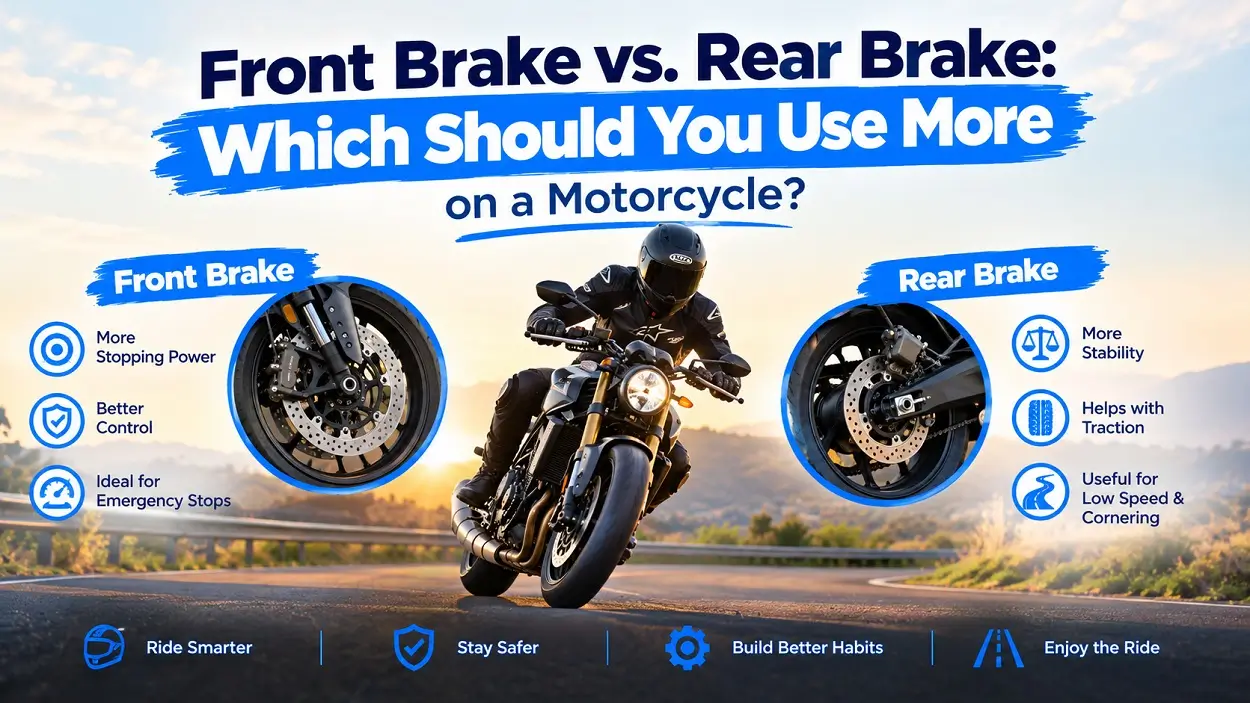
Mostly the front, but not always, and knowing when the rear brake should take the lead is just as important. The front brake supplies roughly 60% to 75% of a motorcycle’s total stopping power in a straight-line stop, which is why it should always be part of your emergency braking. But the rear brake has real jobs of its own: tight, slow-speed turns, gravel or wet pavement, and riding two-up all shift the advantage toward the rear.
Here’s a full breakdown of when to lean on which brake, what the physics and official training manuals actually say about the old “never use the front brake” myth, and exactly how to work both brakes correctly.
So, When Do You Use the Front Brake vs. the Rear Brake?
In most situations you use both brakes together to slow down and stop. To actually slow the bike down, the front brake does most of the work. To control your turning radius while you’re turning, especially at low speed, the rear brake takes the lead. Here’s the simplest way to think about each one, before we get into the physics and the myth-busting.
Quick orientation, in case any of this is new: the front brake is the hand lever on the right side of your handlebars, controlling the front wheel. The rear brake is the foot pedal by your right foot, controlling the back wheel. Every “front” and “rear” below refers to those two controls.
Front Brake vs. Rear Brake: At a Glance
| Front Brake | Rear Brake | |
|---|---|---|
| Control | Hand lever, right side of the handlebar | Foot pedal, by your right foot |
| Share of stopping power | ~60–75% in a straight-line stop | ~25–40%, the rest |
| Typical disc size | Larger, e.g. 296mm on a Honda CB300R, 310mm on a Kawasaki Ninja 500 | Smaller, 220mm on both of those bikes |
| Typical caliper | Multi-piston (2–4 pistons is common) | Usually single-piston |
| Best used for | Straight-line stops, emergency braking, most of your stopping power | Tightening your turning radius, low-speed control, stability on gravel or wet roads, riding two-up |
| If it locks up | High risk, a locked front wheel very often causes a fall | Lower risk, a locked rear usually just skids, and is more recoverable |
| Brake type today | Disc brakes are now standard | Disc is standard; a drum brake still turns up on some smaller or budget bikes’ rear wheel |
That size gap isn’t an accident, it’s the same weight-transfer physics from above. Braking shifts the bike’s weight forward, so the front tire gets more traction to work with and needs a bigger disc and a beefier caliper to handle that load without overheating. That’s why, on most motorcycles, the front brake is visibly larger than the rear.
Use the rear brake to tighten your turning radius. A light touch of rear brake while you’re turning, especially at low speed, shortens how wide the bike swings through the turn and gives you finer control over exactly where it goes. That’s why a gentle dab of rear brake, not front, is what experienced riders reach for in a tight U-turn or a slow parking-lot maneuver: it tucks the turn in without upsetting the bike’s balance.
Use the front brake as your main brake. The instant you start slowing down, the bike’s weight shifts forward onto the front tire. That’s not a minor detail; it’s the whole reason the front brake carries the majority of your stopping power (the exact numbers are below). Because of that weight transfer, the front tire has far more traction to work with under braking than the rear does, which is exactly why the front brake does the heavy lifting any time you actually need to slow down or stop.
Use both together for a real, controlled stop. Anytime you need an emergency stop, or any full stop where losing control isn’t an option, you combine front and rear. The front supplies most of the stopping force, the rear adds stability and shares part of the load, and together they bring the bike down to a stop faster and more predictably than either brake could manage alone.
The rest of this guide gets into exactly when each brake should lead, the physics behind the front brake’s dominance, and how to build the technique so it’s automatic.
Where Did the “Never Use the Front Brake” Myth Come From?
The myth comes from a real but misread experience, not an official source. Grab the front brake hard and fast, especially on a bike that’s upright at low speed, and you genuinely can pitch enough weight forward to lift the rear wheel, what riders call a “stoppie.” That’s a real, physical thing. The mistake is what people learned from it: the lesson should have been “don’t grab the front brake violently,” but it got flattened into “don’t use the front brake at all.”
I heard it the same way most riders do: not from a course, not from a manual, but from a buddy in a parking lot. “Stick to the rear brake, the front one will send you over the bars.” It gets passed down like that, friend to friend, dad to kid, and it sticks because it sounds like it’s protecting you.
That’s the practical consequence of the myth: a rider who never touches the front lever isn’t playing it safe, they’re braking with roughly a quarter of the bike’s real stopping power, every single time they need to stop in a hurry.
How Much Stopping Power Does the Front Brake Really Provide?
More than half, and usually a lot more. California’s DMV (Department of Motor Vehicles) motorcycle handbook puts it at “three-quarters of your total stopping power,” while Colorado State Patrol puts it at 60% or more. The exact share shifts with the bike, part of why your bike’s fit and geometry affects how it handles under braking.
Here’s the practical reason why: the instant you start slowing down, the bike’s weight transfers forward, onto the front tire. That extra weight presses the front contact patch harder into the pavement, which gives the front tire more available traction, and more traction means it can handle more braking force before it slides. The rear wheel is doing the opposite at the same moment: it’s getting lighter, so it has less grip to work with and locks up far more easily.
Colorado State Patrol backs this up with real stopping-distance numbers from 50 mph: rear brake only takes about 278 feet to stop, front brake only takes about 120 feet, and both brakes together take about 105 feet. In plain terms, a rider who only uses the rear brake needs nearly three times the distance to stop compared to using both brakes correctly, and CSP notes that in a majority of motorcycle crashes, the rider never used the front brake at all. At 50 mph, the difference between 278 feet and 105 feet is very possibly the difference between stopping short of the car pulling out in front of you and hitting it.
You may have heard this described as the “70/30 rule.” It’s shorthand for the same idea: roughly 70% of your braking force should come from the front brake, and about 30% from the rear, for a normal straight-line stop. It’s a rule of thumb, not a law of physics, Jalopnik notes it shifts in low-traction conditions like rain or gravel, or when you’re carrying a passenger or heavy luggage, both of which move some of that work back onto the rear brake.
What Do the MSF and State DMV Manuals Actually Teach?
Every official source says the same thing: use both brakes together, and none of them tell beginners to avoid the front brake. I went looking for a single official training source, an MSF (Motorcycle Safety Foundation) course outline, a state DMV (Department of Motor Vehicles) handbook, anything with a government or accredited-training seal on it, that tells beginners to avoid the front brake. I couldn’t find one. Not one.
What every official source actually teaches is the opposite. The Motorcycle Safety Foundation’s Basic RiderCourse, the entry-level class most new riders take before they’re even licensed, builds a dedicated braking exercise around developing “a feel for progressive braking pressure to stop more quickly without skidding,” then layers in full emergency-braking practice later in the course. That’s front and rear together, from day one.
California’s DMV handbook is just as direct: “Use both brakes every time you slow or stop. Using both brakes for ‘normal’ stops helps you develop the proper habit and skill.” It also tells you exactly how, not just that you should: “Squeeze the front brake and press down on the rear brake. Grabbing at the front brake or jamming down on the rear brake can cause the brakes to lock and result in control problems.” Colorado State Patrol frames rear-brake-only riding bluntly, comparing it to “trying to stop a car with only the emergency brake.”
So if a friend, a forum post, or someone’s uncle taught you to skip the front brake, that’s not verified technique, it’s folklore that never made it into a single manual or licensing course in the country.
So Which Brake Should You Use More? A Situation-by-Situation Guide
There’s no single right answer, it depends on what you’re actually doing on the bike.
Straight-line stops and emergencies: lead with the front. In a normal stop or a panic stop, both brakes go on together, but the front carries the majority of the load. If you had to pick just one brake in an emergency, every source agrees: use the front.
Slow-speed maneuvers and U-turns: favor the rear. Below roughly 8–10 mph, think parking lots, tight U-turns, creeping through traffic, the front brake is almost too powerful and grabby to control precisely, and even a light squeeze can tuck the front wheel and put you down. A light touch of rear brake instead tightens your turning radius and smooths out any accidental throttle, without that risk.
Gravel, sand, wet leaves, or anything slick: favor the rear. On low-traction surfaces, the front tire has a lot less grip to work with, and a skidding front wheel is far more likely to end in a low-side crash than a skidding rear wheel. When the road gets sketchy, ease off the front and lean more on the rear.
Riding two-up or loaded with luggage: lean on the rear more than usual. Extra weight on the back of the bike means the rear tire has more traction available than it does when you’re riding solo, which makes the rear brake noticeably more effective than you’re used to.
Cornering: a careful blend, trailing off the front. Braking while leaned over uses up traction the tires would otherwise spend on cornering, so smooth, progressive front pressure that eases off as you settle into the turn, with a touch of rear held through it, is safer than grabbing either brake hard mid-lean.
| Situation | Lead With | Why |
|---|---|---|
| Straight-line or emergency stop | Front (with rear together) | Front carries 60–75% of total stopping power |
| Slow-speed U-turns, parking lots | Rear | Front is too grabby under 8–10 mph and can tuck the wheel |
| Gravel, sand, wet leaves | Rear | Front has less traction to spare; a front skid is more likely to crash |
| Two-up or loaded with luggage | Rear (more than usual) | Extra rear weight means more available rear traction |
| Leaned over in a corner | Front, trailing off smoothly, plus light rear | Cornering already uses up available traction |
The short version: default to using both brakes together, let the front do most of the work in a straight line, and let the rear take over more of the job any time speed drops, traction disappears, or you’re carrying extra weight.
How to Use Both Brakes Correctly as a Beginner
The technique is simpler than the myth makes it sound. Here’s how I’d walk a new rider through it:
- Cover the lever, always. Ride with one or two fingers resting lightly on the front brake lever whenever you’re moving in traffic. That way, when you need it, you’re squeezing immediately instead of reaching for it first, that half-second of reach time is real distance at 30 mph.
- Squeeze the front, don’t grab. Start with light pressure and build it progressively as the bike’s weight shifts forward. This isn’t just a style preference, the harder you brake, the more weight transfers onto the front tire, which means the front tire can actually take more pressure a half-second into the stop than it could at the very start. A grab skips that buildup and asks for more traction than the tire has yet.
- Press the rear, don’t stomp it. Your foot has more leverage than you think, so ease into the rear pedal the same way you ease into the front lever. A locked rear wheel is generally more forgiving than a locked front, riders can often hold it locked and ride the skid to a stop, but a smooth, controlled press still beats a stomp every time.
- Use both brakes together on straight-line stops. Not just in an emergency, every stop, including the boring ones at a red light. That’s how the two-brake habit becomes automatic instead of something you have to remember under pressure.
- Let the rear lead at low speed and on bad traction. In parking-lot U-turns, gravel, or wet pavement, shift your weight toward the rear brake and go easier on the front, see the situation guide above.
- Practice in an empty parking lot before you need it for real. Find open pavement, get up to 15–20 mph, and practice firm, controlled stops using both brakes. This is exactly what the MSF Basic RiderCourse has every student do, it’s not an advanced-rider drill, it’s day-one material.
- Check your lever reach. If the brake lever sits too far from your fingers, you’ll instinctively grab instead of squeeze just to get enough leverage. Most bikes have an adjustable lever for exactly this reason, it’s part of getting your motorcycle’s fit dialed in, not a detail to skip.
- Stay loose. Relaxed arms and a light grip on the bars let the bike settle and the front tire do its job. Locked, tense elbows fight the bike’s natural weight transfer and make a smooth stop harder, not easier.
- Know the order, even if it happens in a blink. MSF’s own braking research found that in the fastest emergency stops, riders apply the rear brake a fraction of a second, about 0.07 to 0.09 seconds, before the front. It’s not something you consciously time; in practice it’s still “both brakes, together.”
Do this enough times in a parking lot, and the front brake stops being a scary unknown and becomes just… how you stop.
What Happens If You Grab Either Brake Too Hard?
Grabbing either brake abruptly can lock a wheel and cause you to lose control, and a locked front wheel is far more dangerous than a locked rear. This is the trade-off worth knowing, because it’s the real risk the myth is (badly) trying to warn you about. Grab the front brake hard and abruptly, and the front tire can lose traction and lock up. Research from the Insurance Institute for Highway Safety is blunt about what happens next: “locking the front wheel is particularly dangerous, with falling down being almost certain.” A locked rear wheel usually just skids, recoverable, if unnerving. A locked front wheel is a different situation entirely, which is why California’s DMV handbook gives it its own instruction: “if the front wheel locks, release the front brake immediately and then re-apply it firmly.” Don’t ride it out. Let go, then squeeze again.
This is also exactly why the fear exists in the first place, and why it backfires. The same IIHS research found that riders worried about locking the front wheel often under-brake instead, applying less force than the situation actually needs, which is its own kind of dangerous. Their fix for that problem is ABS (anti-lock braking system): motorcycles equipped with ABS let a rider squeeze the front brake as hard as the emergency demands without fear of lockup, and IIHS data shows ABS-equipped bikes have a 31% lower fatal crash rate than otherwise-identical non-ABS models.
A few practical notes worth carrying with you: not every beginner-friendly used bike under $5,000 comes with ABS, so the manual technique above still matters even if your next bike has it. If you’re shopping used, worn or spongy brake components make it much harder to judge progressive pressure correctly, so it’s worth adding brakes and brake lines to your pre-purchase red-flags checklist. And if you’re still building confidence with hard stops, practicing in real gear, not just a t-shirt and sneakers, matters, since the right riding gear is what turns a low-speed parking-lot mistake into a non-event instead of road rash.
Front Brake Myths vs. Reality
| Myth | Reality |
|---|---|
| “Never use the front brake, it’ll flip you over the handlebars” | The front brake supplies 60–75% of total stopping power (CA DMV, Colorado State Patrol). Grabbing it violently causes problems, using it correctly does not. |
| Rear brake alone is the safer choice | Rear-only stops from 50 mph take about 278 feet vs. 105 feet using both brakes, nearly 3x the distance (Colorado State Patrol). |
| ABS makes front-brake technique unnecessary | ABS-equipped motorcycles show a 31% lower fatal crash rate, largely because it removes fear of front-wheel lockup (IIHS), but manual technique still matters, especially on non-ABS bikes. |
| If the front wheel locks, hold on and ride it out | Release the front brake immediately, then re-apply firmly (California DMV handbook). A locked front wheel is far more likely to cause a fall than a locked rear. |
| Front-brake technique is for advanced or sport riders | The MSF Basic RiderCourse, the entry-level class most new riders take, builds progressive front-brake practice into its very first braking exercise. |
Frequently Asked Questions
In extreme cases, yes, grabbing the front brake hard while the bike is upright and moving slowly can pitch enough weight forward to lift the rear wheel, sometimes called a “stoppie.” But that takes a hard, sudden, badly-timed grab, not the progressive squeeze taught in every rider-training course. Used correctly, the front brake will not flip you.
Roughly 60% to 75%, depending on the source and the bike. California’s DMV handbook states the front brake provides “three-quarters” of total stopping power; Colorado State Patrol puts it at 60% or more. The exact figure shifts with a motorcycle’s weight distribution and how hard you’re braking, but every official source agrees the front carries the majority.
Yes. Every state motorcycle manual and the MSF Basic RiderCourse teach using both brakes for every stop, not just emergencies. Building that two-brake habit on ordinary, low-pressure stops is what makes it automatic the one time you actually need it in traffic.
No, ABS is a safety net, not a substitute for technique. Learning a proper progressive squeeze still makes your stops shorter and smoother, and not every used beginner motorcycle under $5,000 comes with ABS. IIHS research shows ABS-equipped motorcycles have a 31% lower fatal crash rate, largely because it removes the fear of front-wheel lockup, but you still want to brake correctly rather than relying on the system to bail you out.
Favor the rear brake below about 8–10 mph. The front brake is powerful enough that even a light squeeze can tuck the front wheel during a slow, tight turn. A gentle touch of rear brake instead tightens your turning radius and smooths out the throttle without that risk.
Lean more on the rear brake. Low-traction surfaces leave the front tire with less grip to spare, and a skidding front wheel is far more likely to end in a crash than a skidding rear wheel. Slow your inputs down and favor the rear until you’re back on solid, dry pavement.
The front brake is the lever at your right hand, controlling the front wheel. The rear brake is the pedal by your right foot, controlling the back wheel. Every “front vs. rear” comparison in this guide refers to those two controls.
Yes, for a normal or emergency stop, both brakes go on together, with the front doing most of the work. The main exception is slow, tight maneuvers like U-turns, where riders lean more on the rear alone.
Mainly at very low speed, under about 8–10 mph, in tight U-turns and parking-lot maneuvers, where even a light front-brake squeeze can tuck the wheel. It’s also worth easing off the front, not cutting it out entirely, on gravel, sand, or wet pavement, and while leaned over mid-corner.
You can stop using mostly the front brake, it supplies the majority of your stopping power on its own, but never using the rear isn’t a real technique. You lose the extra stability and stopping distance the rear brake adds, and at low speed the front alone becomes harder to control, not easier.
Cover the front brake lever, squeeze it progressively rather than grabbing it, press the rear pedal smoothly, and use both together for every stop, not just emergencies. The full step-by-step technique is above, in “How to Use Both Brakes Correctly as a Beginner.”
In the fastest emergency stops, MSF’s own braking research found the rear brake engages a fraction of a second, about 0.07 to 0.09 seconds, before the front. It’s not something you consciously time; for practical purposes, both brakes still go on together.
Keep the clutch engaged through most of the stop; the engine’s natural compression drag helps slow the bike, and pulling the clutch in early throws that assistance away. Pull the clutch in only right at the very end of the stop, just before the engine would otherwise stall, not as your first move in an emergency stop.
The front brake does more of the work in a straight-line stop, it’s the brake used most, and the one that matters most in an emergency. But “more important” isn’t the same as “only one that matters”: the rear brake is what keeps you in control at low speed, in a corner, or on a loose surface, so a good rider treats both as essential, just for different jobs.
Leave a Reply