
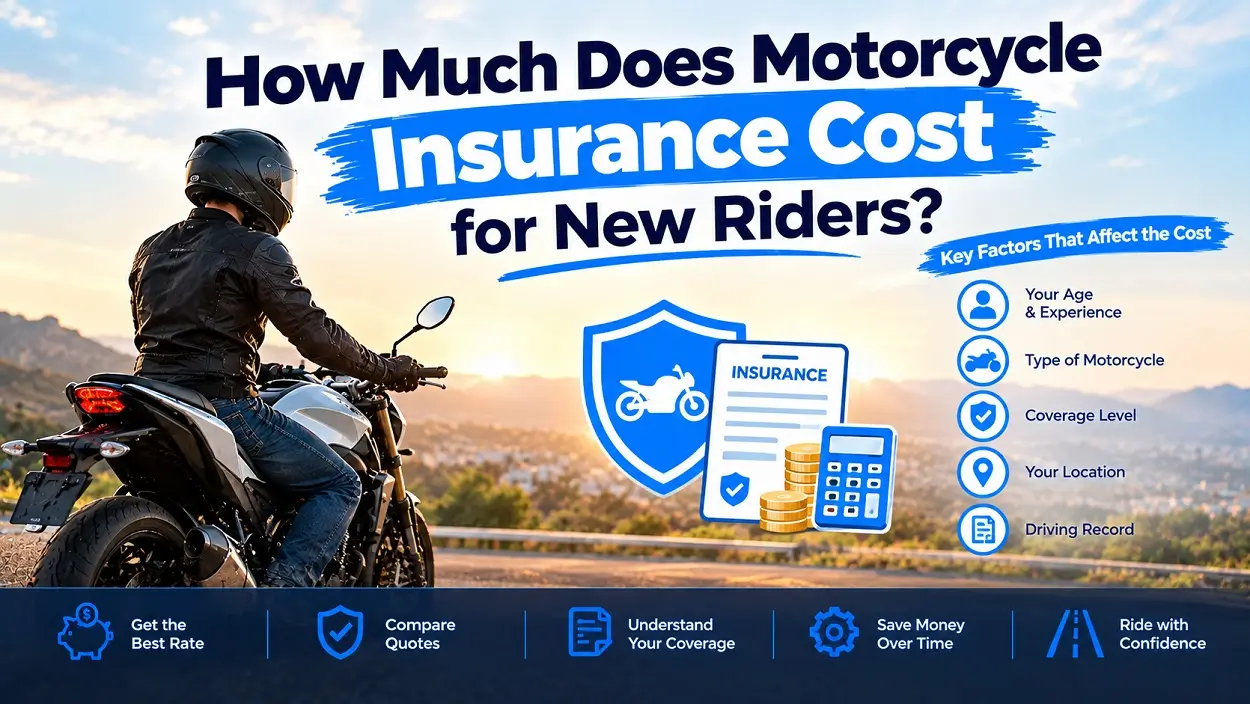
Real motorcycle insurance costs less than a lot of online estimates suggest. For most riders, monthly premiums run about $44 to $148 for full coverage, and $12 to $68 for minimum liability only, according to Allstate and Progressive’s own pricing data. New, young riders pay more on top of that, but the jump is smaller than you’d think, and it’s smallest of all once you know which levers actually move the number.
Is Motorcycle Insurance Legally Required, and What Happens If You Skip It?
In most states, yes. Motorcycle liability insurance is legally required the same way car insurance is, and riding without it can mean fines, a suspended license, and points on your driving record. A few states, like Florida, do not mandate a policy outright, but they still require you to prove you can cover damages another way if you cause a crash, so skipping coverage rarely saves you anything in practice.
If you are caught riding uninsured where it is required, penalties vary by state but commonly include fines running from a few hundred to well over a thousand dollars, plus license or registration suspension for repeat offenses. Harley-Davidson Insurance notes that if you cause an accident while uninsured, you are personally responsible for the other rider’s medical bills and property damage, and insurers will likely charge you more once you do get covered again.
Florida is the clearest exception, and it is worth understanding rather than relying on. Progressive confirms Florida does not require motorcycle insurance by state law, but riders there still have to prove financial responsibility through a policy, a surety bond, or certified self-insurance if they cause injury or property damage. That is a narrow legal loophole, not a real alternative to coverage.
Why Does Motorcycle Insurance Cost So Much More for New Riders?
It isn’t personal, and it isn’t random. GEICO is direct about it: riders under 25, and anyone new to riding, statistically cost more to insure because of inexperience and higher accident risk. Allstate adds that how often you ride, your driving history, and even where you park the bike all factor into the price too.
The good news: this surcharge fades. Every source here agrees the gap narrows fast with a clean riding record, so the extra you pay now is temporary, not permanent.
How Much Does Motorcycle Insurance Actually Cost?
Minimum liability coverage runs about $12 to $68 a month, depending on your insurer and state.
Full coverage, covering your own bike and not just damage to others, runs about $44 to $148 a month for a standard bike, per Allstate.
Progressive backs up the low end: its cheapest liability-only rates range from about $12.62 a month in Pennsylvania to $30.44 a month in Delaware, and its most basic entry policy starts at just $75 a year, about $6 a month.
New and young riders pay more, but not as much as you’d guess. MoneyGeek found a 16-year-old averages about $38 a month for minimum coverage and $121 a month for full coverage, higher than the general range above, but not multiples higher.
The real spike comes from stacking every risk factor at once. A young rider on a high-performance sport bike in an expensive state can push past $200–$250 a month, since age, bike type, and location compound together rather than adding up gently.
Get a real quote before you budget off any of these numbers; the spread between insurers for the identical policy is often bigger than the spread between age groups.
How Much Does Motorcycle Insurance Cost by Age?
It drops fast as you get older. A 16-year-old pays roughly $38 a month for minimum coverage and $121 a month for full coverage, while a 22-year-old pays about $20 a month and $80 a month for the same two coverage tiers, according to MoneyGeek’s age-based cost data.
| Age | Minimum coverage (monthly) | Full coverage (monthly) |
|---|---|---|
| 16 | ~$38 | ~$121 |
| 18 | ~$35 | ~$107 |
| 19 | ~$28 | ~$103 |
| 20 | ~$25 | ~$96 |
| 22 | ~$20 | ~$80 |
These are national averages across all bike types and states, not a quote for a specific rider, so treat them as the general shape of the cost curve rather than your exact price. A 22-year-old on a high-performance sport bike in an expensive state can easily pay more than a 16-year-old on a small standard bike in a cheap one. Age is one factor in the price, not the only one.
How Much Does Your Bike Choice Affect the Price?
Bike type is one of the biggest levers on your premium. GEICO puts it simply: sport bikes and high-performance models cost substantially more to insure than standard or cruiser motorcycles, and a 1,000cc sport bike will typically cost noticeably more than a 250cc beginner-friendly model, even before age or location come into it.
That gap isn’t about the sticker price, it’s about how the bike is statistically ridden. It’s the same math behind one of the most common regrets new riders report: buying more bike than they’re ready for. Before you fall for a specific model, check how your size and riding style actually fit it. A right-sized standard or naked bike is often both the safer first bike and the cheaper one to insure.
What Coverage Do You Actually Need as a Beginner?
As a beginner, you need more than the legal minimum: liability coverage keeps you street legal, but collision and uninsured-motorist coverage are what actually protect you and your bike, since new riders are statistically the most likely to need them. Most states only require liability by law, and legally required is not the same as actually enough, especially on a bike where a single get-off can total your gear, your bike, and a chunk of your savings in one afternoon. Harley-Davidson Insurance breaks down five coverages worth understanding before you buy:
- Liability coverage, pays for injuries or property damage you cause to someone else. This is the legal minimum in most states, and it covers the other person, not you or your bike.
- Comprehensive coverage, pays out for theft, vandalism, fire, and other non-crash damage. Worth real consideration if your bike lives outside or in a shared lot.
- Collision coverage, pays for damage to your own bike from a crash, whether that’s hitting another vehicle or something as simple as dropping it in a parking lot. This is the one new riders most often skip to save money, and the one they most often need.
- Medical payments coverage, covers injury-related medical costs for you and a passenger, regardless of who caused the crash.
- Uninsured motorist coverage, protects you if the other driver doesn’t have insurance at all. The guidance flags this as genuinely important: an estimated one in seven U.S. drivers is uninsured.
The practical read for a new rider: liability-only is cheaper today, but collision and uninsured-motorist coverage are what actually protect you as a beginner, statistically the rider most likely to need them.
How Much Does Your State Matter?
Yes, sometimes more than your age does. Progressive shows liability-only rates ranging from about $12.62 a month in Pennsylvania up to $30.44 a month in Delaware, for the exact same coverage. The pattern behind it: warmer states with longer riding seasons and higher accident and theft rates cost more, while quieter, lower-traffic states cost less.
There’s nothing you can do about which state you live in, but it’s a real reason a national average can be misleading. Always get a quote for your specific ZIP code rather than budgeting off a country-wide number.
How to Lower Your Motorcycle Insurance Cost as a New Rider
Yes, in several concrete ways: taking a safety course, bundling policies, paying upfront, and starting on a smaller bike are the biggest levers. The age-and-risk math above isn’t something you can talk your way around, but insurers themselves list real, specific ways to bring the number down:
- Complete a motorcycle safety course. GEICO cites savings of 5% to 30% for completing an approved course, the same course that teaches the braking fundamentals every new rider needs anyway.
- Install anti-theft and safety equipment. Both Allstate and GEICO note discounts for anti-theft devices, alarms, and ABS (anti-lock braking system).
- Bundle your policies. Combining motorcycle insurance with an existing auto or home policy is one of the most consistently cited discounts across Allstate, Progressive, and GEICO.
- Pay in full and set up autopay. Allstate specifically flags paying your policy upfront and enrolling in automatic payments as discount triggers.
- Start on a smaller, lower-risk bike. Given the gap between a 250cc beginner bike and a 1,000cc sport bike, choosing a smaller-displacement standard or naked bike as your first motorcycle is one of the biggest single levers on your premium.
- Shop at least three insurers before you buy. Rates for an identical policy can vary significantly between companies, loyalty to one insurer costs new riders real money.
- Every source here agrees this is the biggest lever over time. The discounts above shave dollars off today, but a clean riding record is what closes the new-rider gap within a few years.
At a Glance: What Drives Your Monthly Cost
| Factor | Estimated Monthly Range | Source |
|---|---|---|
| Minimum liability (general) | $12–$68 | Allstate / Insurify |
| Full coverage (general, standard bike) | $44–$148 | Allstate / Insurify |
| 16-year-old, minimum coverage | ~$38 | MoneyGeek |
| 16-year-old, full coverage | ~$121 | MoneyGeek |
| Liability-only, cheapest state cited (PA) | ~$12.62 | Progressive |
| Liability-only, priciest state cited (DE) | ~$30.44 | Progressive |
| Entry-level policy, best case | ~$6 ($75/yr) | Progressive |
| Young rider + sport bike + expensive state (stacked risk) | $200–$250+ | Directional, from compounding factors above |
Ranges reflect different insurers and methodologies. Treat them as the shape of the cost, then get a quote for your own age, bike, and ZIP code.
Frequently Asked Questions
How much does motorcycle insurance cost for a new rider per month?
Less than most people expect: about $40 to $150 a month for full coverage, and as low as $12 to $70 for minimum liability. Young riders and sport-bike owners sit toward the higher end; an adult rider on a standard bike sits toward the lower end.
How much does full coverage motorcycle insurance cost?
About $44 to $148 a month for a standard bike, according to Allstate, more if you are young, ride a sport bike, or live in a higher-cost state. That is on top of what a liability-only policy costs, since full coverage adds protection for your own bike rather than replacing the liability requirement.
How much is motorcycle insurance normally?
There is no single normal price, since age, bike type, coverage level, and state all move the number. As a realistic middle ground, a typical rider with full coverage on a standard bike lands somewhere between $40 and $70 a month, with minimum liability running well under $30 a month for most riders outside the highest-risk groups.
How much is motorcycle insurance per month?
Monthly cost typically runs $12 to $68 for minimum liability and $44 to $148 for full coverage, with the exact number depending mostly on your age, your bike, and your state. See the cost breakdown above for how each factor moves the price.
Can I buy motorcycle insurance online?
Yes. All of the major insurers cited in this guide, including Allstate, Progressive, and GEICO, let you get a quote and buy a policy online in a few minutes, without visiting an office or calling an agent. It is usually the fastest way to compare real numbers for your specific bike and ZIP code rather than relying on national averages.
Does a motorcycle safety course actually lower your insurance rate?
Yes. GEICO cites savings of 5% to 30% for completing a recognized course like the Motorcycle Safety Foundation (MSF) Basic RiderCourse, on top of the riding-skill benefits of taking it. It’s one of the few discounts a brand-new rider can qualify for immediately.
Is a sport bike really that much more expensive to insure than a cruiser?
Yes. GEICO confirms sport bikes and high-performance models cost substantially more than standard or cruiser bikes, with a 1,000cc sport bike typically costing noticeably more than a 250cc beginner-friendly model. Insurers price the category based on how it’s statistically ridden, not just what it costs to buy.
Should a new rider get full coverage or just liability?
Liability-only is cheaper and meets the legal minimum in most states, but it only pays for damage you cause to others, not your own bike or medical bills. Given that new riders are statistically the most likely to drop or crash a bike, collision and uninsured-motorist coverage are worth the extra cost even on a tight budget.
Does insurance cost less on a used motorcycle than a new one?
Often, since insurers weigh a bike’s value and repair cost alongside its category and risk profile. It’s one more reason buying used can make sense for a first motorcycle, but get an actual quote on the specific bike before assuming, since a used sport bike can still cost more to insure than a new standard.
Is there such a thing as one-day motorcycle insurance?
Not really, at least not from the mainstream insurers cited in this guide. Progressive is direct about it: most major motorcycle insurers do not offer short-term or pay-as-you-go policies. If you only need coverage briefly, riding someone else’s bike is usually better handled through the owner’s own policy or a named-rider addition, not a standalone one-day policy.
Can I buy motorcycle insurance for multiple years at once, like a 5-year policy?
No, not as a single multi-year policy. Motorcycle insurance in the US is sold in standard terms, usually six months or a year, that you renew or pay upfront. Paying a year in full rather than monthly is a real discount insurers offer, but a 5-year premium is simply five years of your annual cost added together, not a distinct cheaper product.
Leave a Reply