
Written by a rider who’s bought and sold more than a dozen motorcycles, new and used, since he was 17.
New or used for your first motorcycle isn’t just a question of what’s on the price tag – it’s a bigger decision than that. I’ve put a serious number of miles on a lot of bikes at this point, and bought plenty of them both new and used. So here’s where I’ve landed, personally: I don’t buy new from the dealer anymore. What I do buy is a bike that’s a year or two old, already past the steepest part of its depreciation, with relatively low mileage – somewhere around 10,000 miles.
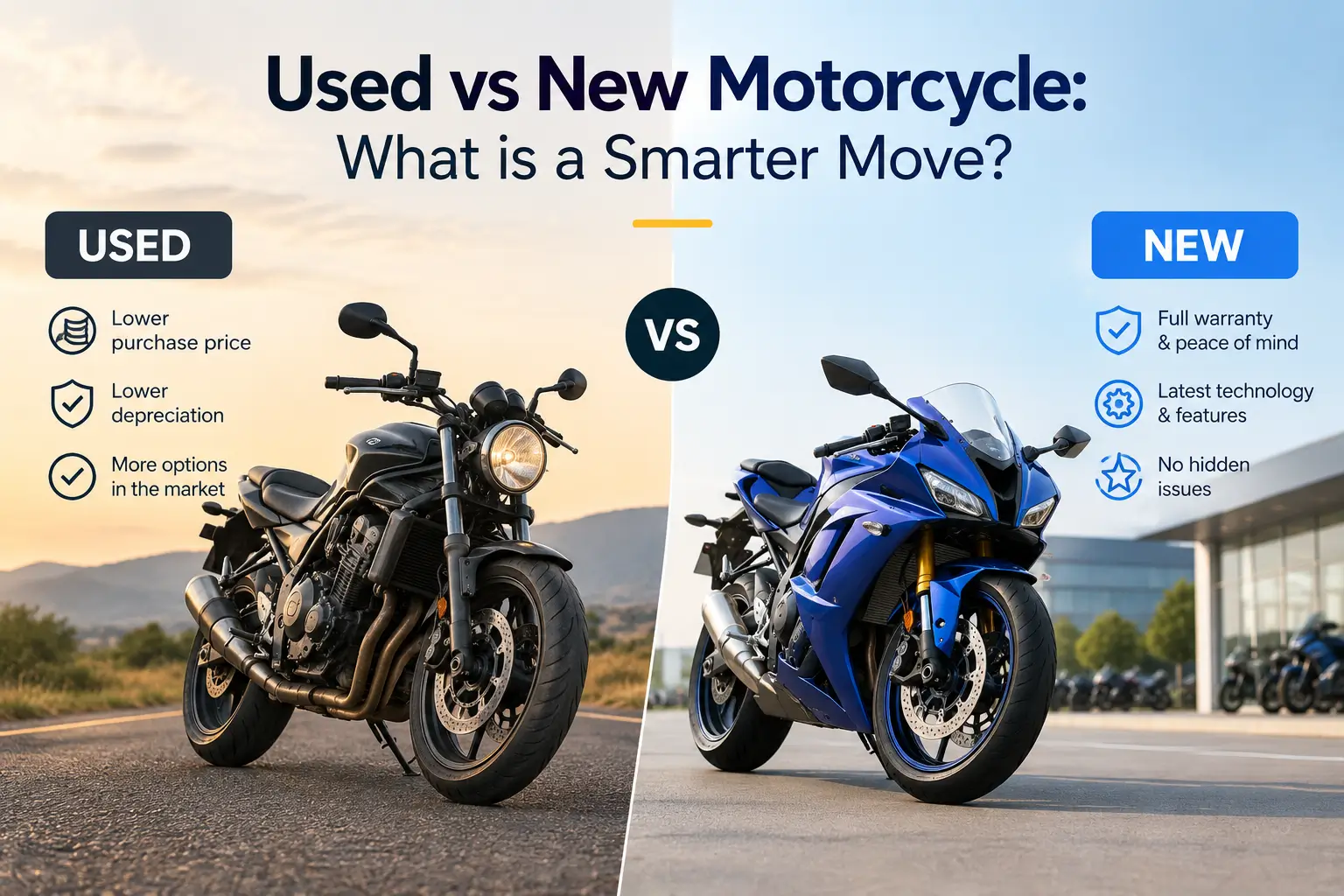
Quick answer: for most first-time riders, a used motorcycle one to two years old with low mileage is the smarter buy – you skip the worst depreciation, the break-in period is already done, and you can resell it with little loss once you know what you actually want. A brand new bike mainly buys you zero unknown history.
Why Buy a Used Motorcycle for Your First Bike?
The purchase price is the obvious reason, and not just because most of us are working with a tighter budget for a first bike. It’s because a brand new motorcycle can lose up to 25% of its value almost as soon as you ride it off the lot, especially on models that aren’t big sellers. Your first bike is also almost never going to be your forever bike – you’re still figuring out your riding style, the riding position that actually fits you, the seat height you’re comfortable with. Buying used lets you go through that whole learning phase without losing a ton of money while you do it.
There’s a less obvious reason too. New bikes usually show up “naked” – no extras. If you want any, you’re either paying a lot more or waiting for the right parts from the right supplier. A lot of used bikes already come loaded: a top box, soft luggage, a phone mount, some extra lighting. You won’t want every add-on the previous owner picked, but in almost every case it’s cheaper and easier to pull accessories off a bike than to add them yourself.
So Beyond the Money – Why Not Buy New as Your First Bike?
Like I said above, on our first bike we’re not “shaped” yet – we don’t know what kind of rider we are, what we actually like, what type of bike really fits us. That kind of figuring-out is better done on a bike that isn’t demanding a break-in period and the service that comes right after it. Buy a used motorcycle or scooter and you’re usually getting one that’s already past that first-service stage – you don’t have to watch the tach and keep it under 1,500-2,000 RPM, which is what most break-in periods call for, and the tires have already scrubbed off that factory shine and actually started gripping the road.
Bottom line: you’re buying something you can ride exactly the way you want and need to, right away.
How Much Does a New Motorcycle Cost vs. a Used One?
I’ll use the Honda CB500F here as the example – it’s one of the most common first bikes in the US, and one I know well.
| Condition | Year | Price | Mileage | Warranty status | Listing |
|---|---|---|---|---|---|
| New (current factory MSRP) | 2026 CB500 Hornet – the current name for this bike | $5,899 + $600 destination = $6,499 | 0 mi | Full 1-year, unlimited-mileage, transferable factory warranty from delivery | Honda Powersports (official) |
| New (real dealer stock, outgoing name) | 2025 CB500F | $6,899 | 1 mi | Full factory warranty | Lifestyle Honda, Mt. Vernon WA |
| Used, nearly new | 2025 CB500F ABS | $5,499 | 1,837 mi | Likely still has months left on the factory warranty since it’s transferable – confirm the in-service date with the seller | Mineolamoto, Mineola NY |
| Used, 1-2 years old (my sweet spot) | 2024 CB500F ABS | $4,298 | 13,451 mi | Factory warranty has almost certainly run out – ask if the seller bought a HondaCare protection plan, since those transfer too | Atlantic Cycle & Power, White Plains MD |
| Used, 2-3 years old | 2023 CB500F ABS | $5,495 | 14,600 mi | Factory warranty expired | Lucky U Cycles, Fort Myers FL |
Average savings, used vs. new: $6,499 new vs. ~$5,097 average across the three used listings above = about $1,402 saved, roughly 22%
The CB500 Hornet isn’t a new, separate bike – it’s the CB500F with a new name and a $1,000 lower price tag for 2026, otherwise unchanged. So if you’re cross-shopping, don’t be confused seeing both names for what’s mechanically the same motorcycle.
Financing and Insurance: New vs. Used
Money doesn’t stop at the sticker price. If you’re financing, new bikes usually get you the better rate – lower APR, longer terms – but you’re borrowing against a bigger number that starts losing value the second you ride off the lot. Used bikes are financeable too, but expect a higher rate and a shorter term, and some lenders won’t touch anything past a certain age or mileage – worth a call to your bank or credit union before you fall for a specific bike. Insurance is the easier part: it’s almost always cheaper on a used bike, since you’re insuring a lower value. Run both numbers – financing and insurance – before you decide, not just the price tag.
What to Check When Buying a Used Motorcycle vs. New
On a new bike, the manufacturer hands you something that’s already ready to ride. Your job is basically oil level and tire pressure, then just showing up for the scheduled maintenance.
On a used bike, you need to confirm the systems are actually worth what you’re paying. The big ones: brakes, and engine oil – check the color, the level, and whether there’s any sign of a leak. Start it up and listen. I’m not expecting you, or anyone reading this, to be a motorcycle mechanic – so here’s what “listen” actually means in practice: you want an engine that idles steady, without RPM surging up and down for no reason, and no metal-on-metal knocking sounds. And honestly, the most useful tool you have is your own gut. If it sounds off to you, it probably is – and walking away costs you nothing. Another bike will come along.
Then take it to a mechanic you trust for a full check of every system, and if you decide to buy it, do a small service of your own right away: oil, oil filter, and a chain lube if it has a chain.
Check the Title Before You Hand Over Any Money
This part has nothing to do with how the bike sounds or rides, and it’s just as important. Get the VIN off the bike itself, not just the listing, and make sure it matches the title exactly – digit by digit. Run it through NICB’s free VINCheck to see if it’s ever been reported stolen, and if you want to go a step further, a paid report from CycleVin or a similar service will flag salvage titles, flood damage, and accident history that a seller might not mention. Confirm the name on the title actually matches the person selling it to you, and if there’s a lien listed, call the lienholder yourself to confirm it’s been paid off – don’t just take the seller’s word for it. If you’re buying from a private seller, meet somewhere public, and it’s smart to bring someone with you. None of this is paranoia – it’s a few minutes of work that protects you completely, and it costs a lot less than finding out the hard way.
See: What to Check Before Buying a Used Motorcycle
Frequently Asked Questions
Yes, as long as you check it properly first. Brakes, oil condition, and how the engine sounds at startup tell you almost everything – if those check out and a trusted mechanic confirms it, a used first motorcycle isn’t inherently less safe than a new one.
There’s no hard cutoff, but low tens of thousands of miles (roughly 10,000-15,000) on a well-maintained bike is a reasonable range for a first-time buyer – it’s usually past the break-in period without carrying serious wear.
Sometimes. Honda’s factory warranty is transferable, so a used bike still within its first year from the original in-service date can carry the balance of that coverage. Ask the seller for the in-service date, and whether they bought an extended protection plan, since those can transfer too.
Almost always. New motorcycles can lose up to 25% of their value very quickly, so a one- to two-year-old bike with low mileage typically costs 20-30% less than the same bike new, without the break-in hassle.
Brakes, engine oil color and level, and how the engine sounds when it starts – no RPM surging, no metal-on-metal knocking. Then get a trusted mechanic to check it fully before you commit.
The Bottom Line, From Someone Who’s Done This Wrong a Few Times
I’ve bought new more than six times now, and wasted a real amount of money doing it. There’s something genuinely fun about a brand new bike – nobody’s ridden it before you, it’s entirely yours. Sometimes that’s worth it to you, and that’s a fine reason. But personally, I don’t recommend it for a first bike.
From 17 to 21, I went through more than four motorcycles. Looking back, it genuinely wasn’t worth the money.
Sources & a Note on the Screenshot
You asked for a screenshot from the site each price came from – I couldn’t produce one. The sandboxed environment this research ran in blocks direct browser/screenshot access to commercial listing sites like Cycle Trader at the network level (not a bot-detection issue I could work around – a hard policy on my end), so I pulled the live listing data itself (price, mileage, dealer, date) from each page’s actual content instead, and linked every listing above. You can open any of them and grab a screenshot in two clicks, or link this project to your computer and I can drive a browser there next time.
- 2025 Honda CB500F – Honda Powersports (official pricing)
- 2026 Honda CB500 Hornet price cut – Ultimate Motorcycling
- 2025 Honda CB500F listings – Motorcycles on Autotrader
- Used Honda CB500F listings – MotoHunt
All prices and mileage figures are current as of today; motorcycle listings turn over fast, so re-verify before this goes live.
Leave a Reply